


There are two basic reference methods for LED plant lighting for plant growth or planting.
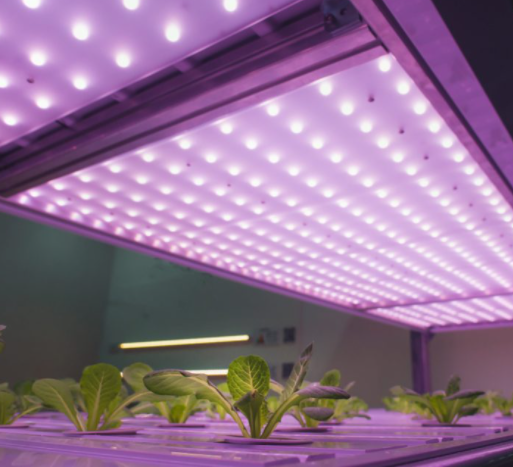
At present, the indoor planting model is very hot in China. This model has several characteristics:
①The role of LED lights is to provide the full spectrum of plant lighting, and the lamps are required to provide all the lighting energy, and the production cost is relatively high;
②The design of LED plant growth lights needs to consider the continuity and integrity of the spectrum;
③It is necessary to effectively control the lighting time and lighting intensity, such as letting the plants rest for a few hours, the intensity of the irradiation is not enough or too strong, etc.;
④The whole process needs to imitate the conditions required by the actual optimal growth environment of plants outdoors, such as humidity, temperature, and CO2 concentration.
Outdoor planting mode with a good outdoor greenhouse planting foundation. The characteristics of this model are:
① The role of LED lights is to grow light. One is to enhance the light intensity in the blue and red areas under the condition of sunlight during the day to promote photosynthesis of plants, and the other is to compensate when there is no sunlight at night to promote plants. Growth rate;
② The supplementary light needs to consider which growth stage the plant is in, such as the seedling period or the flowering and fruiting period.
Therefore, the design of LED plant boosting lights should first have two basic design modes, namely, all-weather lighting (indoor) and plant growth grow light (outdoor). For indoor plant cultivation, the design of LED plant booster lights needs to consider three aspects, as shown in Figure 4. It is not possible to package the chips with three primary colors in a certain proportion.
First of all, China’s outdoor greenhouse planting has decades of experience, with a large amount and a wide range, both in the south and the north. It has a good base of greenhouse planting technology and provides a large number of fresh fruits and vegetables on the market for surrounding cities, especially where there is soil, water, and fertilizer. A wealth of research results have been achieved in planting.
Secondly, this kind of supplemental light solution can greatly reduce unnecessary consumption of energy, and at the same time can effectively increase the yield of fruits and vegetables. In addition, my country has a vast geographical area, which is very convenient for promotion.
As the scientific research of LED plant lighting, also provides a broader experimental base for it.
According to the above design ideas, the research team conducted a series of experiments, and the experimental results are very significant. For example, the nursery booster lamp originally used a fluorescent lamp with a power of 32 W and a nursery cycle of 40 days. We provide a 12 W LED light, which shortens the seedling cycle to 30 days, effectively reduces the influence of the temperature of the lamps in the seedling workshop and saves the power consumption of the air conditioner. The thickness, length, and color of the seedlings are better than the original seedling raising scheme. For the seedlings of common vegetables, good verification conclusions have also been obtained, which are summarized in the following table.
Among them, the PPFD of the supplementary light group: 70~80 ol -2 -1, red to the blue ratio: 0.6 to 0.7; the natural group's daytime PPFD value range is 40 to 800 ol -2 -1, red to blue ratio : 0.6~1.2. It can be seen that the above indicators are better than those of naturally grown seedlings.


