


The "new normal" in the post-epidemic era will have a major impact on our workplaces in response to new people's general anxiety and behaviors. Employees will naturally be more cautious when using shared surfaces (such as light switches, doors, beverage dispensers, soap dispensers, and toilet bowls). In addition, life after COVID-19 may result in the need to limit and monitor the number of people in the office. In particular, facility managers need to make more preparations to control services and minimize the energy wasted by lighting unused areas, with the goal of optimizing space utilization and saving energy costs.
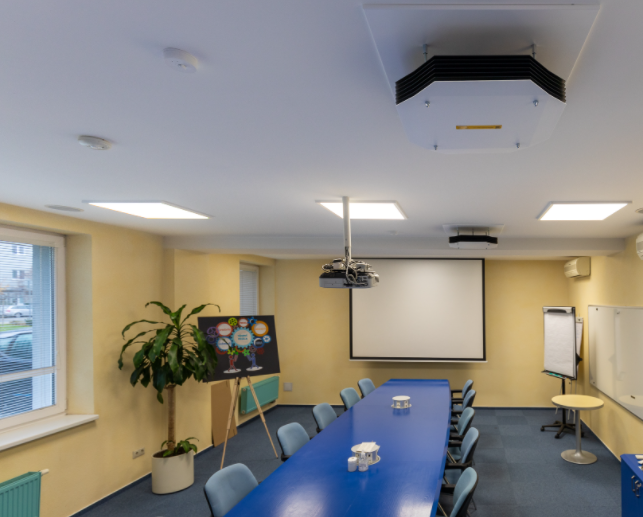
Fortunately, there are many solutions in the office that can be used for lighting and building management. Technology that has been hidden in the background for a long time will eventually be applied in our workplaces to control occupancy, save energy and eliminate the need to touch shared surfaces.
Thermal sensor
Facility managers have an ever-increasing demand for personnel detection systems. If there are no personnel on site, lighting and other services will be automatically turned off. Temperature measurement can be used to detect whether there are people in the space and confirm whether the system is operational. Such thermal sensors require a wide field of view so that they can accurately and reliably detect the presence and position of people in space.
For example, the Omron D6T thermal sensor is based on an infrared sensor that can measure the surface temperature of people and objects without touching them. It is achieved by using thermopile elements that absorb the radiant energy emitted by the target object. The latest MEMS thermopile is integrated with a custom-designed sensor ASIC that bundles signal processing microprocessors and algorithms in a small package. Therefore, the sensor is believed to provide the industry's highest signal-to-noise ratio (SNR).
For lighting applications, D6T 32x32 (wide-angle version based on 32 x 32 elements) can provide a viewing angle of 90.0°x 90.0°. This is equivalent to measuring a 360cm x 360cm field of view at a distance of 2m, so people can be detected in a wide space. When used effectively, such thermal sensors can monitor movement and occupancy rates around buildings to make better use of office space. They can also control lighting and HVAC to save energy.
Light Convergence Sensor
Every day in the workplace and other public environments, we touch countless switches, and hundreds of complete strangers are also touching them. Before the outbreak of COVID, all of us did not hesitate to reach out for a light switch in a room, but we have to be more cautious these days. Fortunately, non-contact sensors provide an ideal solution that can be easily implemented in environments that need to reduce the spread of harmful bacteria and viruses. The latest equipment provides excellent performance, with a longer detection distance and a convergent beam, which can accurately trigger objects in a tightly designated target area, ignoring any objects in the background or foreground.
For example, Omron B5W-LB LCR is a light-converging reflection sensor, its detection performance is reliable and repeatable. The convergent beam of the sensor can be precisely set to trigger when there is an object in a tightly specified target area (the available sensing distances are 55mm and 10mm), while ignoring any objects in the background or foreground. The rugged design can withstand any environment, and designers can use digital outputs to implement simple, easy-to-integrate electronic controls to consistently provide the expected performance. In short, this is a highly reliable non-contact detection that can control the light without touching the switch.
Relay
If these sensors are the "eyes and ears" of the building automation system, then it also needs "hands" to respond. It needs to control the output: heaters, lights, fans, and other components. The relay is still a good solution. They have one or more relay contact outputs, which can provide switching outputs for interlocking or scanning circuits. In addition, they can switch AC or DC voltage separately and meet insulation or glow-wire test requirements at the same time.
Because the load varies greatly and the latest technology puts forward new requirements on the relay, these devices need to meet a series of different requirements. Certain applications have their own challenges. For example, LED lighting, water pumps, and capacitor input filters with power factor correction can generate high inrush currents. This puts a huge load on the relay contacts.
With this in mind, Omron’s G5RL relay series is dedicated to lighting control. The new G5RL-K-EL latch type has passed IEC60669-1 16A 140F certification and is ideal for controlling fluorescent and LED lights. With its single-contact innovative structure, it has the best price-performance ratio on the market.
Omron's G5RL series also provides an approved G5RL-HR TV-8 monostable version, which can switch to 16A current and can handle high surge currents up to 150A. Models G5RL-U and G5RL-K are also available in latch versions with TV-8 certification.
For smaller loads, Omron offers compact 10A G5Q series. The G5Q-1A-EL2 type is specially developed for capacitive surge currents in the range. This relay can switch the inrush current of 40 A / 100 s and the nominal cut-off current of 1 A / 250 V AC, up to 100,000 times, so it is very suitable for lamp loads.


