


"All things grow by the sun". Light is one of the essential elements of crop photosynthesis. The conditions of light directly affect the quality of crops. In nature, the sun's illumination will vary with latitude, season and weather conditions. In addition to the above factors, light inside the greenhouse is also closely related to the greenhouse structure, management practices and translucent properties of the materials and the like. Due to the impact of greenhouse covering materials, dust and structural factors such as shading, lighting situation inside the greenhouse is much less than the open field, typically only exposed to a 30% -70%. Especially during the winter and early spring, the solar attitude is low and the sunshine duration is short, thus the greenhouse illumination often can not meet the needs of crop growth and artificial light has become an inevitable choice for many a controlled environment greenhouse management.
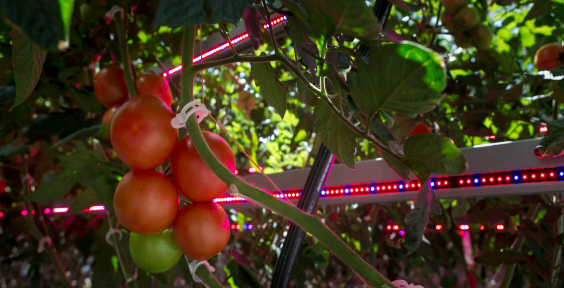
At present, the commonly used artificial light sources of greenhouse mainly fluorescent lamps, high pressure sodium, low pressure sodium, metal halide lamps. In recent years, with the successful development of high-power LED, new energy-saving LED light source also attracted wide attention.
LED (light emitting diode) light source developed in recent years is a new energy source. Compared with incandescent, fluorescent and high pressure sodium lamps and other artificial light sources, LED has significant advantages:
· Low-voltage DC power supply. Low-power color LED forward voltage is typically 1.5V-2.8V, high power LED forward voltage is typically 3V-4V, far less than the safety voltage.
· Energy saving. Sodium and metal halide lamps are gas discharge lamps, heated up by the metal element vapor discharge light. LED light source is a solid, no heating can emit light, is a cold light source, so it reduces power consumption in the heating.
· Monochromatic light source has high luminous efficiency. LED may emit monochromatic light of a half-wave of a large multi-± 20nm, can accurately provide the required spectrum of plants, without wasting energy emits yellow light, green light and other plants unnecessary spectrum.
· Small in size and flexible in applications. Light fixtures can be designed in small sizes and the application space is large.
· Environmental protection. LED is a solid light source, no mercury and other harmful substances will not cause pollution in the installation, which waste can be recycled. LED light source is environmentally friendly green light.
· Long lifespan. LED is a solid light source, there is no loose interior parts, no glass, filament and other vulnerable and easy to burn parts, mechanical strength, resistance to vibration, impact resistance, life up to 50000h more.
Obvious advantages of LED light sources has caused scholar concerns from Netherlands, Japan, the United States and other countries, especially in recent years the successful development of high-power LED has laid foundation for the application of filling light in greenhouse. Being the topic of conversations but having no further integration standards will also cause customer retreats.


